Best Time to Visit Tokyo for Sightseeing: A Month-by-Month Guide
The best time to visit Tokyo for sightseeing is November, when rainfall drops to its lowest point outside the depths of winter and daytime highs stay mild enough for a full day of walking, biking or a coach circuit. Late March into the first days of April, when the cherry blossoms peak around 30 March, is the strong runner-up if bigger crowds and a higher chance of rain don't bother you. The window to avoid outright is the very end of April into early May: Golden Week runs 29 April to 5 May and is one of Japan's two annual domestic-travel peaks, packing trains and popular stops with local holidaymakers. Below is the month-by-month breakdown, tied to the specific tours that handle each season best.
Quick answer
The best time to visit Tokyo for sightseeing is November, when rainfall falls to its lowest point outside deep winter and daytime highs stay comfortable for walking, biking and coach tours alike. Late March into early April, timed to the cherry blossom peak around 30 March, is the strong runner-up if you don't mind bigger crowds and a higher chance of rain. Match the month to the right format across the Tokyo tour lineup.
Key takeaways
- November is the single best month: rainfall drops to 95mm, the lowest outside December and January, with a comfortable high of 17.1°C
- Late March into early April is the runner-up, timed to the cherry blossom peak around 30 March, though rain and crowds both climb
- Avoid the very end of April into early May: Golden Week, 29 April to 5 May, is one of Japan's two annual domestic-travel peaks
- Counterintuitively, September and October, not the tsuyu rainy season, are Tokyo's wettest months of the year at 225mm and 235mm
- Mornings beat afternoons for nearly every tour on this site; the one built-in exception is the Shinjuku night walk
- Obon, in mid-August, is Japan's other domestic-travel peak, and it lands during the hottest stretch of the year at up to 31.4°C
Seasons at a Glance
The table below reads left to right: a conditions column, a weather column, then a crowd note and a short Verdict. A Verdict of "avoid" means outdoor sightseeing gets genuinely harder that month, not that Tokyo shuts down; the city runs fine indoors and on a coach whatever the calendar says.
| Month | Touring Conditions | Weather | Crowds | Verdict |
|---|---|---|---|---|
| January | Clear skies suit walking routes; coldest month of the year | Cold, dry | Low, quiet after New Year | Cold, clear, good value |
| February | Driest month; crisp light for photos | Cold, dry | Low | Driest month, still cold |
| March | Blossom viewing opens up outdoor stops | Mild, rain rising | Moderate, rising with the blossoms | Blossoms begin, crowds building |
| April | Peak blossom week gives way to Golden Week congestion | Mild, showers | High, peaking at month's end | Peak blossom, Golden Week |
| May | Warm enough for a full day on foot or coach | Warm, showers | Peak early month, easing after | Golden Week rush, then quiet |
| June | Coach tours handle the wet mid-month start better than walks | Humid, tsuyu begins | Moderate | Rainy season starts mid-month |
| July | Wet first half, properly hot second half | Hot, humid | Moderate to high | Wet start, humid end |
| August | Early departures beat the day's peak heat | Hottest, humid | High, Obon mid-month | Hottest month, Obon crowds |
| September | Typhoon risk can disrupt outdoor plans with little notice | Wet, typhoon risk | Moderate | Typhoon peak, avoid |
| October | The year's wettest month; typhoons still possible early on | Wet, cooling | Moderate | Wettest month, typhoons linger |
| November | Mild and dry, the easiest month to plan a full day around | Mild, dry | Moderate | Best overall |
| December | Cold but dry; illuminations draw evening crowds | Cold, dry | Rising toward New Year | Cold, dry, holiday crowds |
The Two Standout Months
Two months stand well clear of the rest: November, for its combination of mild air and the lowest rainfall outside deep winter, and the last days of March into early April for the cherry blossoms, if you're willing to trade some of that calm for crowds and a higher rain chance. September and October are the two to plan around carefully, both wetter than the rainy season itself. The same clear-air months do the most for your camera; where each tour is worth photographing breaks the spots down stop by stop.
The Raw Numbers, Month by Month
The same year, in raw numbers. Highs and lows in Celsius, rainfall in millimetres, based on 1991 to 2020 climate normals for Tokyo.
| Month | High | Low | Rain |
|---|---|---|---|
| January | 10°C | 2.1°C | 60mm |
| February | 10.8°C | 2.6°C | 55mm |
| March | 13.9°C | 5.4°C | 115mm |
| April | 19.1°C | 10.4°C | 135mm |
| May | 23.5°C | 15.3°C | 140mm |
| June | 26°C | 19.2°C | 170mm |
| July | 30°C | 23.1°C | 155mm |
| August | 31.4°C | 24.3°C | 155mm |
| September | 27.6°C | 20.8°C | 225mm |
| October | 22.2°C | 15.3°C | 235mm |
| November | 17.1°C | 9.6°C | 95mm |
| December | 12.4°C | 4.5°C | 60mm |
August is the hottest month at 31.4°C, January the coldest at a low of 2.1°C, and October the wettest at 235mm, ahead of every month in the tsuyu rainy season. Figures come from the Japan Meteorological Agency's 1991 to 2020 climate normals; check the current forecast close to your dates, since any single year can run warmer, cooler or wetter than the long-term average.
Best Season by Traveler Type
If you want the best photos
come for the cherry blossom peak, around 30 March through the first days of April, when Tokyo's parks and temple approaches are at their most photogenic despite the crowds.
If you're traveling with family or want the calmest possible day
aim for November, the mildest and driest month of the year; our Tokyo tours with kids guide covers which specific tour suits which age.
If you're working with a tight budget
travel January or February, once the New Year crowds thin. Both sit outside the Golden Week and Obon price peaks, even though they're the coldest months of the year.
If your dates fall in typhoon season, September into early October, and can't move
lean on an enclosed coach or a flexible private guide rather than a fixed-route walk; see what changes when you go private.
If you're mainly there for shopping and food and don't mind the heat
July or August still work well; the full-day coach's Asakusa matcha stop and market stalls run at full pace through summer.
Spring (March to May): Cherry Blossoms and Rising Crowds
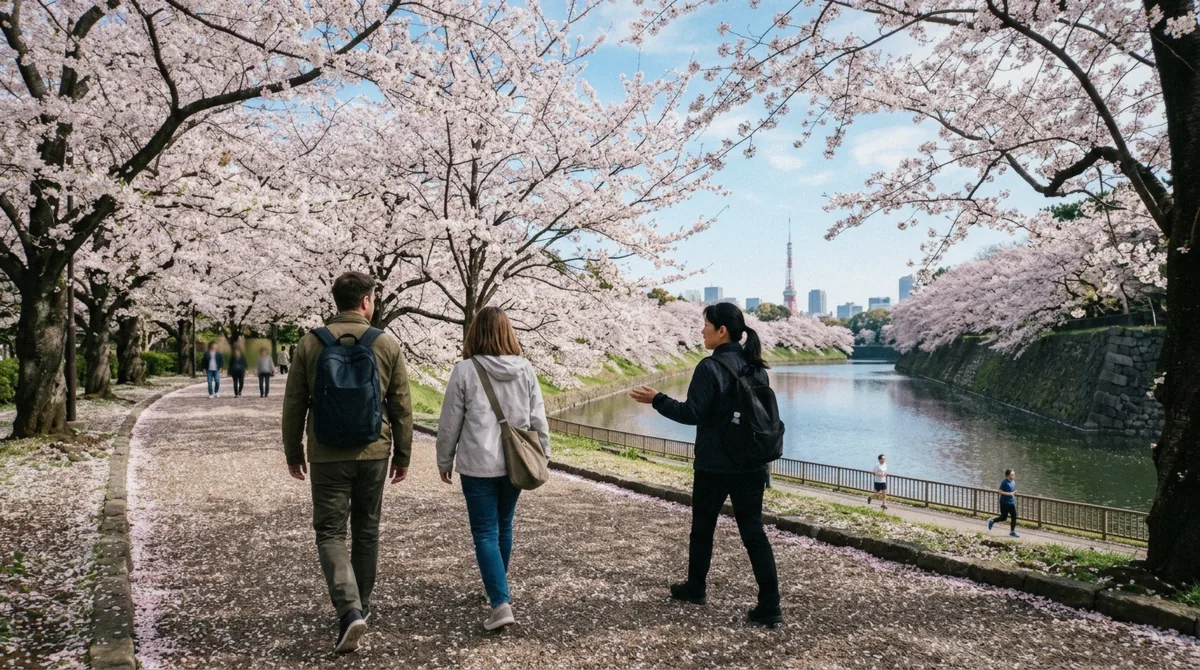
Spring opens cool and closes warm. March starts at a high of 13.9°C and climbs to 23.5°C by the end of May, while rainfall rises the whole way, from 115mm in March to 140mm in May. The season's headline event is the cherry blossom bloom, which typically peaks around 30 March across central Tokyo, drawing the year's biggest short-term crowd spike to parks like Ueno and the moat around the Imperial Palace.
That crowd only grows once Golden Week arrives, 29 April to 5 May, one of Japan's two annual domestic-travel peaks, when trains run packed and popular stops book out well ahead. A fixed-departure day like the full-day coach circuit copes with blossom-week and Golden Week crowds better than trying to walk between packed viewpoints on your own schedule, since the itinerary and the seat are already locked in.
- Highs climb from 13.9°C in March to 23.5°C in May
- Rainfall rises steadily, from 115mm in March to 140mm in May
- Cherry blossoms peak around 30 March; book blossom-week tours early
- Golden Week, 29 April to 5 May, is one of Japan's two domestic-travel peaks
Summer (June to August): Heat, a Rainy Start, and Evenings That Beat the Sun
The tsuyu rainy season opens summer somewhere around the middle of June and typically lingers into the middle of July, bringing humid, unpredictable days that favor an enclosed coach over a long walk. Once it clears, Tokyo turns properly hot: July hits a high of 30°C and August pushes to 31.4°C, the year's warmest month, with humidity that makes early starts and shaded stops matter more than the thermometer alone suggests. Obon, the mid-August holiday week, is summer's own domestic-travel peak, adding crowds to an already demanding stretch.
The smartest adjustment isn't avoiding summer, since school-holiday travelers often can't, it's shifting activity toward the evening. A two-hour night walk through Shinjuku trades the afternoon's heat for neon-lit backstreets and noticeably cooler air, the single best antidote to an August afternoon on this site.
- Tsuyu, the rainy season, runs roughly mid-June to mid-July
- July and August bring highs of 30°C and 31.4°C, the year's hottest stretch
- Obon, in mid-August, is summer's own domestic-travel peak
- Evening tours trade daytime heat for cooler night air
Autumn (September to November): Typhoon Risk Fades Into the Year's Clearest Air
Autumn is where Tokyo's weather genuinely surprises people. September and October are the wettest months of the entire year, at 225mm and 235mm, well ahead of anything the rainy season produces, because typhoon activity peaks across exactly this stretch, running heaviest from August into early October. Outdoor plans in early autumn are the most likely to need a same-day rethink of anywhere on the calendar.
Then, abruptly, November clears: rainfall drops to 95mm and highs settle at a comfortable 17.1°C, producing the calmest, most reliable month of the year for a full day outdoors. If your dates land in the riskier early stretch, a private guide can shuffle the day's order around a forecast in a way a fixed-departure coach can't, moving an outdoor stop earlier or later around a passing system instead of cancelling it outright.
- September (225mm) and October (235mm) are the year's wettest months, driven by lingering typhoon activity
- Typhoon risk runs heaviest from August into early October
- November drops to 95mm of rain and a mild 17.1°C high, the calmest month of the year
- A private guide can rearrange a day around a forecast; a fixed coach can't
Winter (December to February): Cold, Dry Air and the Year's Quietest Streets
Winter is Tokyo's coldest stretch and, alongside November, its driest. January is the cold extreme, with a low of 2.1°C, while February edges out every other month for dryness at just 55mm of rain. What winter lacks in warmth it makes up for in clear light and thin crowds outside the first few days of January, when local New Year shrine visits briefly fill the busiest ones.
Layer up and the season rewards walking: skies stay clear far more often than in the humid months, and a two-hour walk through Shibuya and Harajuku stays genuinely comfortable even at the coldest point of the year, since you're moving the entire time rather than standing at a bus stop.
- January's low of 2.1°C makes it the coldest month of the year
- February is the driest month on record, at 55mm of rain
- Crowds are lowest outside the first few days of January
- A moving two-hour walk stays comfortable even at winter's coldest
What Actually Affects Tokyo's Weather
Most people assume Tokyo's rainy season, tsuyu, is the wettest stretch of the year. It isn't. Tsuyu brings 170mm in June and 155mm in July, real totals, but September and October land 225mm and 235mm, both driven by typhoon activity rather than the seasonal drizzle tsuyu is known for.
The mechanism is straightforward: Japan sits in the direct path of the Pacific typhoon track, and while storms can form any time from roughly June through October, the track runs closest to Honshu, the main island Tokyo sits on, from August into early October. A single typhoon passing near or over the city can drop more rain in a day than a typical week of tsuyu drizzle, which is why the September and October totals climb so far past the rainy-season months that get all the reputation. None of this means outdoor tours stop running; coaches and covered stops handle a wet day far better than an open-air walk, which is the real planning takeaway more than the calendar month itself.
The Best Month If You Only Have One Morning
If your travel dates are still flexible, rank the shortlist this way. November comes first: the lowest rainfall outside deep winter and a comfortable 17.1°C high, with no real trade-off attached. Late March into the very first days of April comes second, timed just ahead of the cherry blossom peak around 30 March, when the trees are close to full bloom but the very worst of blossom-week crowds hasn't landed yet.
February is third: cold, but the driest month on the calendar and the quietest outside the New Year's first few days. Late October is fourth, once the worst of typhoon season has usually passed, though October's own rainfall total is the highest of the year, so treat it as a fallback rather than a first choice.
The Worst Time to Visit Tokyo (Honestly)
September is the honest answer. It combines the second-highest rainfall total of the year, 225mm, with the thick of typhoon season, meaning outdoor plans carry a real chance of a same-day change. It still works for two kinds of traveler: bargain hunters, since it sits well outside the cherry blossom and Golden Week price peaks and Obon's mid-August crowds, and anyone whose main interest is indoor Tokyo: museums, department stores, and the covered arcades around Asakusa and Akihabara, none of which care what the sky is doing.
First-time visitors building a tight, mostly outdoor itinerary around one or two fixed days are the ones who should look at a different month if their dates allow it.
Best Time of Day for Tokyo Sightseeing
Morning wins for almost every tour on this site. Crowds at the Imperial Palace and Senso-ji both build steadily from mid-morning onward, and from June through September the heat and humidity climb the same way, so an early departure buys cooler air and thinner crowds at once. The one built-in exception is the Shinjuku and Kabukicho night walk, designed around after-dark neon and bar-lit alleys that simply don't exist in daylight.
In August especially, an early bike tour departure is worth asking for specifically, since the ride covers the Imperial Palace moat and Shiba Park before the day's heat, tracked at a high of 31.4°C in the temperature table above, has fully built.
Crowds and Prices Through the Year
Three windows account for most of the year's crowding at Tokyo's major stops. The cherry blossom peak around 30 March draws a short, sharp spike focused on a handful of parks and temple approaches. Golden Week, 29 April to 5 May, is broader and longer, filling trains and popular sights nationwide as domestic travelers take their own week off.
Obon, in mid-August, does the same again, layered on top of the year's hottest weather. All three push hotel prices toward their highest points of the year; outside them, January through February and most of June sit at the opposite end, both quieter and generally cheaper, even if neither is anyone's idea of ideal weather. For exactly what each tour costs across the calendar, see the full price breakdown.
What If the Weather Turns?
Light rain rarely stops a Tokyo tour outright. Coaches and covered stops keep running through the kind of showers tsuyu and the shoulder seasons produce most days; what actually forces a change is a typhoon making a close pass, which is rare enough on any single date but real enough across September and October that it's worth knowing the pattern exists. The full-day coach itinerary already documents one concrete example: its Tokyo Bay ferry stop is swapped for Hamarikyu Gardens or the Fukagawa Edo museum on the days it's suspended for weather, no refund attached, which is the kind of substitution worth expecting rather than being surprised by.
Building one spare half-day into a September or October trip is a reasonable hedge if your schedule allows it.
November earns the best-month label on the numbers alone: the lowest rainfall outside deep winter, a comfortable high, and none of the three big crowd spikes that mark the rest of the calendar. Late March into early April is worth the trade if the cherry blossoms matter more to you than a quiet morning at the Imperial Palace. Whatever month lands on your itinerary, the difference usually comes down to matching the day's format, coach, bike, or a walk, to that month's actual conditions rather than fighting them.
See how every tour matches up: compare Tokyo city tours before you lock in dates.
Frequently Asked Questions
What is the best month to visit Tokyo for sightseeing?
November, on the numbers: it has the lowest rainfall outside deep winter, at 95mm, and a comfortable high of 17.1°C. Late March into early April, timed to the cherry blossom peak around 30 March, is the strongest alternative if you don't mind more rain and bigger crowds.
Is Tokyo worth visiting during the rainy season, tsuyu?
Yes, with the right expectations. Tsuyu runs roughly mid-June to mid-July and brings real but manageable rainfall, 170mm and 155mm across the two months. A coach-based day like the full-day tour handles the showers far better than a walking-only itinerary, and museums and covered arcades fill in easily around a wet morning.
When is typhoon season in Tokyo?
Roughly June through October, with activity concentrated from August into early October. September and October end up as the year's wettest months as a result, ahead of tsuyu itself. A same-day itinerary change is possible during this window; it isn't common on any single date, but it's real enough to plan a spare half-day around if your trip lands here.
Morning or afternoon, which is better for Tokyo sightseeing?
Morning, for nearly every tour on this site. Crowds and, in summer, heat both build through the day. The one exception is the Shinjuku night walk, built specifically around after-dark streets.
When are Tokyo tours and hotels cheapest?
January and February, and most of June, sit outside the year's three crowd peaks: the cherry blossom week, Golden Week, and Obon, and tend to run cheaper as a result, even though none of the three is anyone's first choice for weather.
Should I avoid Golden Week entirely?
Not necessarily, but plan around it. Golden Week runs 29 April to 5 May and is one of Japan's two biggest domestic-travel weeks; tours still run, but trains, popular stops and accommodation all get noticeably busier and pricier. Booking your dates well ahead matters more here than in almost any other week of the year.